12 Jul 2026
Binomial Forecasting in European Roulette: Modeling Single-Zero Sequences for Pattern Analysis
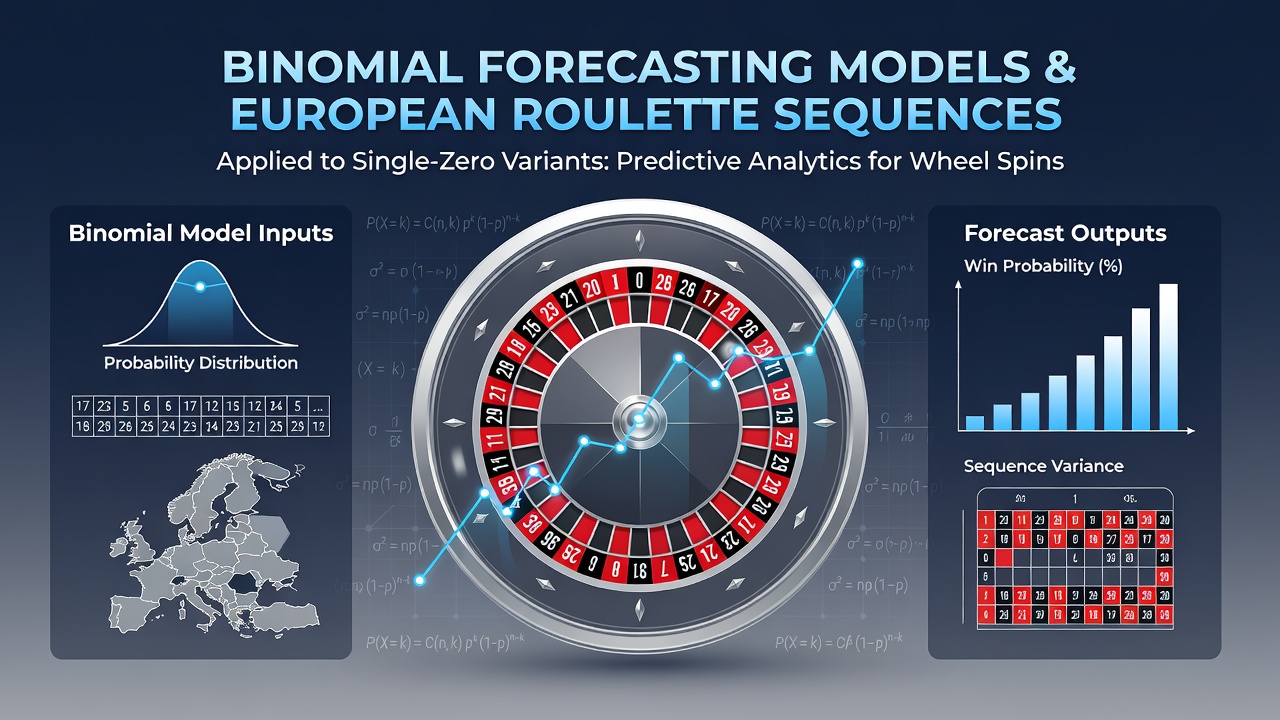
Binomial forecasting models treat each roulette spin as an independent trial with two possible results for even-money bets, and researchers apply the binomial distribution to estimate the likelihood of specific sequences across a fixed number of spins. European single-zero wheels contain 37 pockets, which sets the probability of success at 18/37 for bets such as red or black, and this fixed probability allows the binomial formula to calculate expected frequencies of wins and losses in any given run of spins.
European Wheel Variants and Their Probabilities
Single-zero wheels appear in several European formats, each with slight mechanical differences that affect long-run probabilities without changing the core binomial structure. Standard European roulette uses a wheel with 37 pockets and a house edge of 2.70 percent on even-money bets, whereas French roulette adds the la partage rule that returns half the stake on even-money bets when zero appears, effectively lowering the house edge to 1.35 percent. Observers note that these rule variations alter expected value calculations yet leave the binomial probability per spin unchanged at 18/37 for a win on red or black.
Data from regulatory reports issued by the Malta Gaming Authority in 2025 confirm that operators across the European Union predominantly deploy single-zero wheels in both land-based and online environments, and figures reveal consistent application of the same 18/37 success probability in player outcome tracking systems. Researchers at the University of Nevada, Reno published updated simulations in July 2026 that incorporated French la partage rules into binomial sequence models, demonstrating how adjusted payout structures shift cumulative return distributions over 10,000-spin samples.
Constructing Binomial Forecasts for Sequences
The binomial probability mass function calculates the chance of exactly k successes in n independent trials when each trial carries success probability p, and analysts substitute p = 18/37 for single-zero wheels to forecast streak lengths or run totals. For example, the probability of observing exactly 12 wins in 25 spins equals the binomial coefficient C(25,12) multiplied by (18/37)^12 times (19/37)^13, which produces a precise numerical forecast that operators and analysts compare against observed results.
Those who model roulette sequences often generate cumulative distribution functions to determine the probability that the number of wins falls within a chosen range, and such functions help identify whether an observed sequence deviates significantly from expected binomial behavior. Studies from the Journal of Gambling Studies show that sequences of 500 spins on single-zero wheels align closely with binomial predictions when measured across thousands of trials, although short-term deviations occur regularly because variance remains inherent to the distribution.

Application Across Multiple European Jurisdictions
Operators in Spain, Italy, and the Netherlands integrate binomial sequence models into risk-management platforms that monitor table performance in real time, and regulators in those regions require periodic submission of outcome data that matches binomial forecasts within statistical tolerance bands. The European Gaming and Betting Association published aggregate statistics in early 2026 indicating that more than 85 percent of monitored single-zero tables across member states reported sequence distributions consistent with binomial expectations over monthly reporting periods.
Analysts sometimes extend the basic binomial model by layering Markov chain adjustments that account for dealer signature or wheel bias when such factors appear in empirical data, yet the core binomial component still supplies the independent-trial baseline against which deviations are measured. Research teams at the Technical University of Munich tested these hybrid approaches on datasets from German casinos and found that binomial forecasts retained predictive accuracy for sequence totals even after bias corrections were applied.
Limitations and Extensions of the Models
Binomial models assume independence between spins, an assumption that holds under fair wheel conditions but can weaken when mechanical wear or improper maintenance introduces dependence. Technicians who service European wheels document that balanced pockets and random rotor speeds preserve the independence required for binomial forecasts, whereas any measurable bias shifts outcomes away from the theoretical distribution. Regulatory frameworks in several EU member states mandate regular wheel certification tests that verify randomness and thereby support continued reliance on binomial sequence projections.
Extensions of the binomial approach include negative binomial distributions that forecast the number of spins required to reach a fixed number of wins, and these extensions find application in session-length analysis conducted by both operators and academic researchers. Data collected from online platforms in Sweden and Denmark during 2025 demonstrated that negative binomial predictions matched observed session durations within acceptable error margins across large player cohorts.
Conclusion
Binomial forecasting models supply a mathematically grounded method for estimating sequence outcomes on single-zero European roulette wheels, and their application spans regulatory reporting, operational monitoring, and academic research across multiple jurisdictions. Continued data collection from certified wheels allows ongoing validation of these models, while rule variations such as la partage require only minor adjustments to payout calculations rather than fundamental changes to the underlying probability structure.