19 Jul 2026
Breaking Down Payline Configurations in Five-Reel Video Slots and Their Role in Determining Expected Value
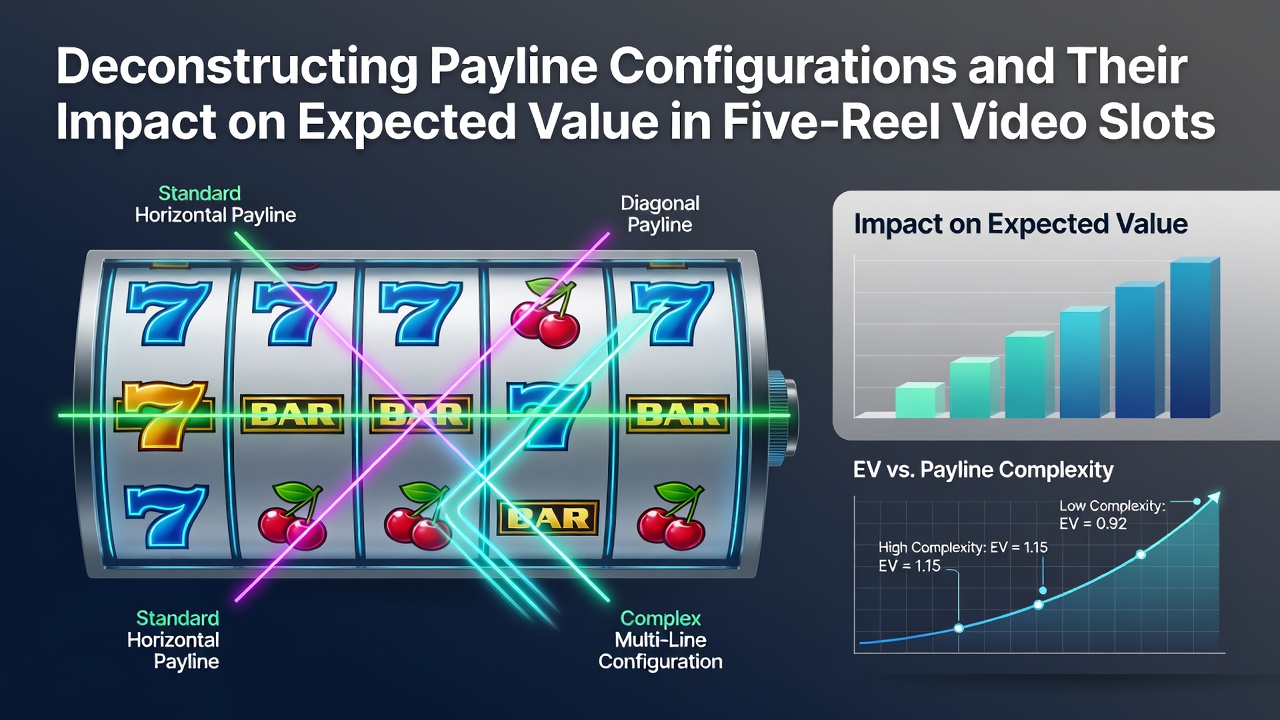
Five-reel video slots rely on payline configurations to determine winning combinations, and these setups directly shape the expected value calculations that define long-term returns for any given game. Paylines represent specific patterns across the reels where matching symbols must land to produce payouts, and operators program these lines in fixed or selectable formats that alter hit rates and prize distribution. Data from regulatory testing labs shows that the number of active paylines, their geometric paths, and whether they operate as fixed or optional lines all feed into teh overall return-to-player percentage that developers publish for each title.
Core Components of Payline Structures
Traditional setups in five-reel games typically offer between nine and fifty paylines that run horizontally, diagonally, or in zig-zag patterns, while modern variants replace fixed lines with 243 or 1024 ways-to-win systems that evaluate every possible symbol combination across adjacent reels. Researchers at institutions such as the University of Nevada, Las Vegas have documented how these different frameworks change symbol weighting and reel strip design, which in turn modifies the probability distribution of outcomes. Fixed paylines require players to wager per line, so increasing the number of active lines raises the total bet amount while proportionally expanding the opportunities for smaller wins, yet the underlying expected value remains anchored to the game's programmed reel mathematics.
Calculating Expected Value Through Configuration Variables
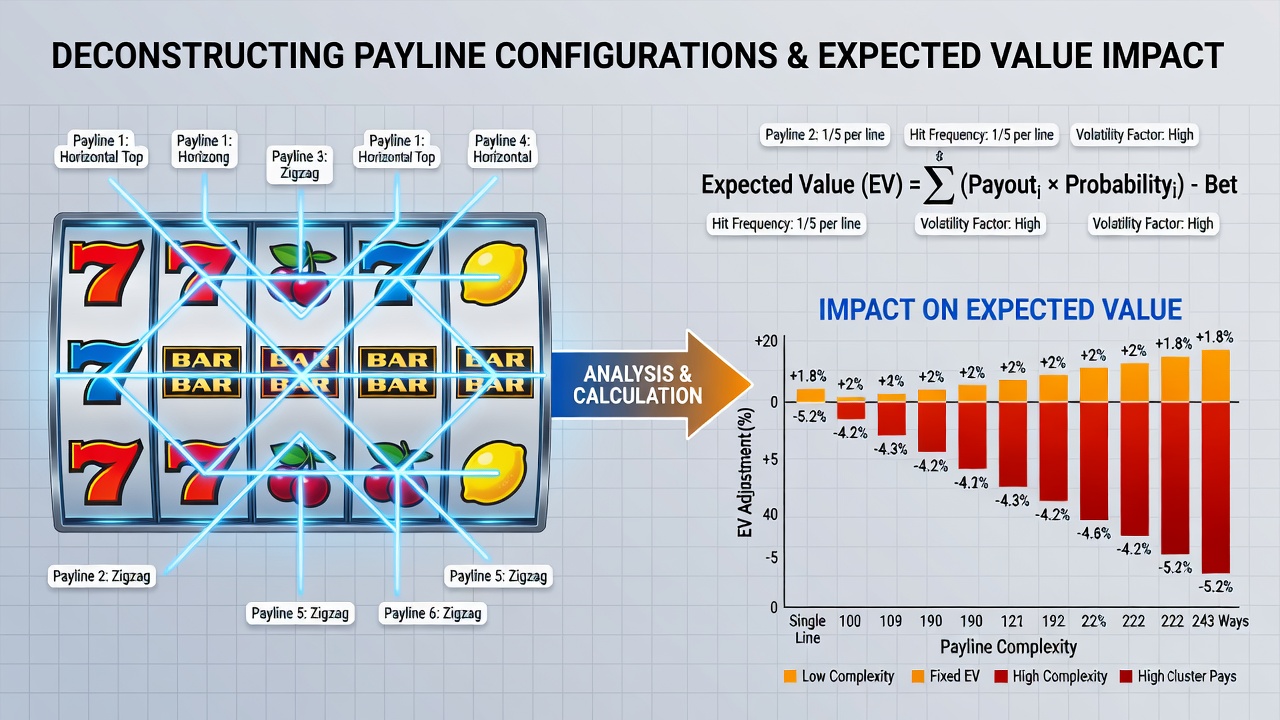
Expected value emerges from the formula that multiplies each possible outcome's probability by its payout multiplier and sums the results across the entire paytable. When payline counts rise, the frequency of low-value hits often increases because more patterns become eligible for evaluation, but this adjustment frequently coincides with reduced multipliers on individual lines to maintain the target return-to-player ratio. Studies published by the Nevada Gaming Control Board indicate that games with 20 fixed paylines versus 40 fixed paylines exhibit measurable differences in hit frequency, even when both titles list identical return-to-player percentages, because the additional lines dilute the average payout per winning event. Operators adjust reel strips and symbol frequencies accordingly, so two titles that appear similar on the surface can deliver distinct volatility profiles once the payline geometry is deconstructed.
Ways-to-Win Systems and Their Mathematical Implications
Games that employ ways-to-win mechanics instead of traditional lines evaluate every left-to-right combination without requiring specific patterns, which changes the combinatorial space from linear to exponential. A 243-ways configuration on five reels multiplies symbol positions across adjacent reels, creating thousands of potential outcomes per spin and altering the expected value calculation because each symbol position carries equal weight regardless of vertical alignment. Industry reports compiled by the Australian Communications and Media Authority reveal that these systems typically produce higher hit frequencies than fixed-line counterparts at the same return-to-player level, yet the average win size per event decreases because the total number of evaluated combinations expands without a corresponding increase in the prize pool. Developers compensate by concentrating higher-value symbols on middle reels or by introducing stacked symbols that trigger multiple ways simultaneously.
Volatility, Hit Frequency, and Player Session Dynamics
Payline configuration influences not only theoretical expected value but also the short-term variance that players experience during individual sessions. Titles with fewer active lines tend to produce larger but less frequent payouts because the game concentrates prize money across a smaller set of patterns, whereas high-line or ways-to-win formats spread returns across more outcomes. Observers note that this redistribution does not change the long-term expected value, which stays fixed by the random number generator and paytable, but it does modify the distribution of bankroll fluctuations within any given sample of spins. Regulatory filings from multiple jurisdictions confirm that testing laboratories verify these parameters through millions of simulated spins before certifying a title for release, ensuring the published return-to-player figure accurately reflects the underlying payline mathematics.
Conclusion
Payline configurations in five-reel video slots serve as the structural foundation that translates raw reel probabilities into tangible expected value outcomes. Whether operators deploy fixed lines, selectable lines, or ways-to-win frameworks, each choice reshapes hit frequency, prize distribution, and session volatility while preserving the core return-to-player percentage programmed into the game. Data from gaming control authorities and academic research continues to demonstrate that players who examine these configurations gain a clearer picture of how individual titles allocate returns across different bet sizes and line counts.