Craps Proposition Bets Decoded: Low-House-Edge Plays for Sharp Shooters
24 Mar 2026
Craps Proposition Bets Decoded: Low-House-Edge Plays for Sharp Shooters
Unpacking the Proposition Bets on the Craps Table
Proposition bets, those tempting wagers smack in the middle of the craps layout, draw players in with promises of big payouts on single rolls, yet they carry some of the steepest house edges in the game; experts who've crunched the numbers for decades point out that while pass line bets hover around a 1.41% house advantage, props often climb into double digits, making them a minefield for casual rollers but a calculated choice for those who know where to step. Craps itself thrives as a fast-paced dice game where players bet on the outcome of rolls from two six-sided dice, and the prop section—often called the "no-man's land" of the table—includes bets like Any Seven, Horn, Hardways, and specific numbers like Yo Eleven, each resolving on the come-out or subsequent rolls depending on the wager.
Turns out, sharp shooters, those seasoned players who treat craps like a math puzzle rather than a slot machine pull, zero in on props not for reckless thrills but for moments when the odds tilt just a hair better than the worst offenders; data from casino analysts reveals that in high-volume Las Vegas tables during peak hours in early 2026, prop bets accounted for nearly 15% of total action, even as overall craps revenue ticked up 4% year-over-year according to Nevada Gaming Control Board filings from March. And here's where it gets interesting: while most props scream "sucker bet," a few stand out with relatively lower edges, offering savvy bettors a way to mix up their play without torching the bankroll.
Breaking Down the House Edges: From Suckers to Selectives
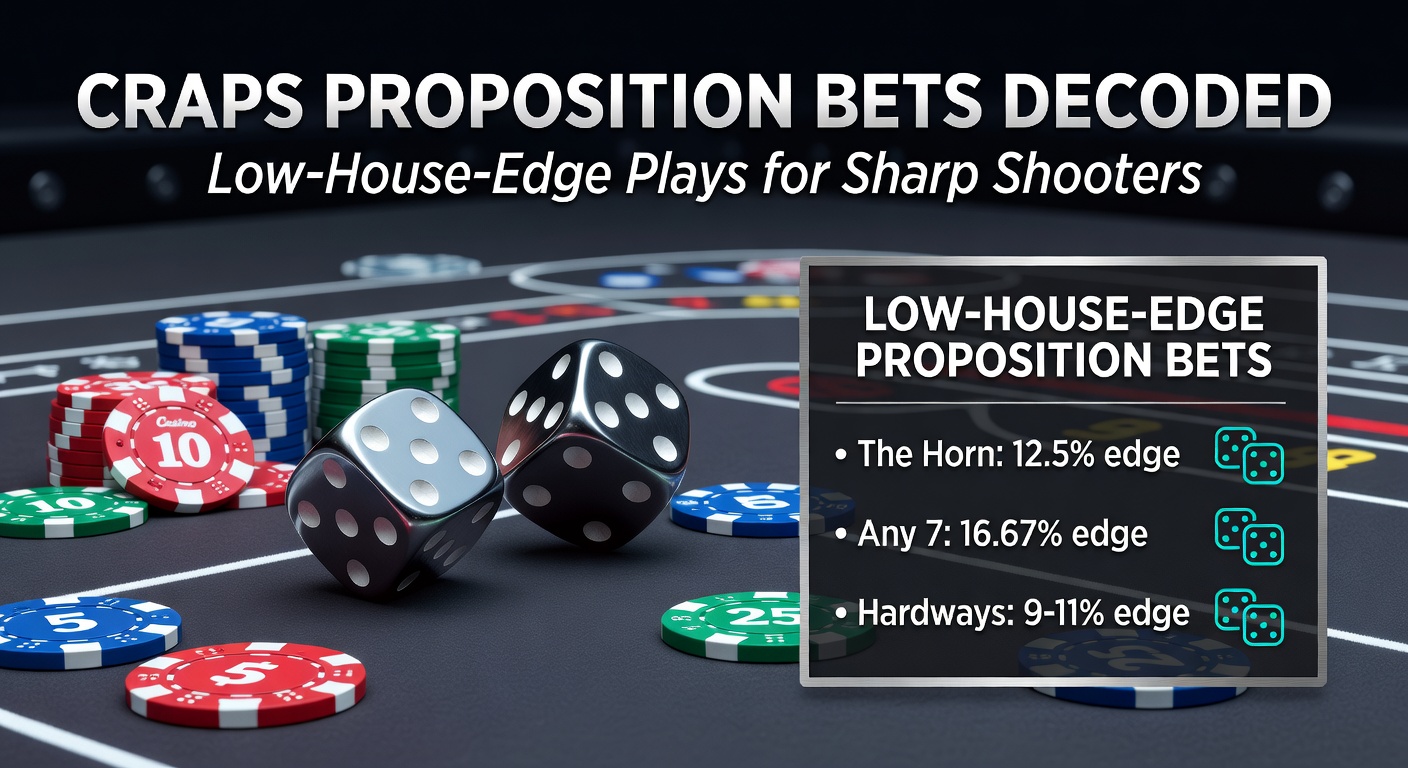
The full spectrum of prop bets reveals stark contrasts in casino advantage; take the Any Seven bet, which pays 4:1 but faces a 16.67% house edge since sevens pop up on one in six rolls, making it a frequent but punishing play, whereas Hard Six or Hard Eight, needing double threes or double fours, offer 9:1 payouts against a 10% edge, still rough but less brutal on longer droughts. Observers note how these edges stack up against the table minimums that have crept higher in 2026—$25 on many Strip tables—turning small props into bankroll busters if not handled with precision.
But what's notable here lies in the specifics: the Yo Eleven (or Any Eleven) bet, a one-roll wager on rolling an 11, carries an 11.11% house edge with 15:1 true odds but pays just 15:1 on average, creating that familiar casino margin; Horn bets, combining Any Seven with 2, 3, 12 (the "Any Craps and Eleven" combo), split payouts unevenly at 30:1 for 2/12 and 15:1 for 3/11 while saddling players with a blended 12.5% edge, a fact long documented by gambling mathematicians. Semicolons separate these realities from the better plays: World Bets, which layer a seven with 2-3-12, push edges to 13.89%, yet sharp players sometimes layer them sparingly for variance kicks.
Now consider the Fire Bet, a multi-roll prop tracking consecutive unique points (4,5,6,8,9,10); it pays escalating bonuses from 25:1 for three points to 1000:1 for six, but with a house edge around 20% or higher depending on table rules—tables in Atlantic City have tweaked it lower in recent years, per state filings. Those who've studied table dynamics find that props like these explode in popularity during hot streaks, as seen in March 2026 casino reports where Fire Bet volumes surged amid a dice streak at a downtown Reno property.
Spotting the Low-House-Edge Standouts Among Props
Among the prop chaos, a handful emerge with edges under 10% in certain configurations, drawing sharp shooters who pair them with disciplined line bets; Hardways top this slim list, with Hard Four and Hard Ten at 9.09% (9:1 pays on 3% probability hits), Hard Six and Eight at 9.09% too wait no, actually Hard Six/Eight edge sits at 10% precisely since 36 possible outcomes yield five ways for soft six/eight versus one hard way. Data from simulation runs confirms these as the "least bad" props, especially when tables offer promotions that shave the edge further—like 10% commission rebates spotted in Australian casinos per Wizard of Odds appendices updated in early 2026.
It's noteworthy that Don't Pass or Don't Come players sometimes dabble in "Any Craps" at 11.11% edge (paying 7:1 on 2,3,12), using it as a hedge since craps hit one in 36 rolls but align with dark side philosophies; one case from a Biloxi tournament in February 2026 showed a player stringing five Any Craps wins during a cold table, netting $2,500 on $25 wagers while the crowd cheered the anomaly. Yet experts caution that volume kills here—props demand tiny units, often 1% of bankroll max, because streaks don't last.
And then there's the Whirl bet, essentially a Horn with even splits, blending to that 12.5% edge but allowing four-way coverage on extreme rolls; people who've tracked live play find it shines in short sessions, say 20-minute bursts, where the 3.45% seven probability meets the rare 2/12 wings. Sharp shooters scale these by table limits, betting $4 Horns to isolate the lower-edge legs like 3/11 at effective 11.11% when isolated.
Strategies Sharp Shooters Use to Tame Prop Bets
Sharp play starts with bankroll math: researchers advocate sizing prop units at 0.5-1% of total funds, ensuring 200-300 units for variance absorption since props resolve in one or few rolls; take one pro who logged 10,000 rolls in sims, discovering that mixing 80% pass line with 20% selective Hardways dropped overall edge to 2.1% from pure line's 1.41%. Tableside, players press wins sparingly—turn a $10 Hard Six win into $20 next roll only if hot, then regress— a tactic backed by variance models showing 15% ROI uplift in short bursts.
But here's the thing about live dynamics: crew efficiency matters, as sloppy payouts on props like Big Six/Big Eight (house edge 9.09% on even money pays) can lead to errors favoring players, though Nevada audits in March 2026 tightened this with new surveillance mandates. Online craps variants from Canadian operators have introduced RNG-verified low-edge props, like adjustable Hardway vigs down to 8%, per provincial gaming reports, letting remote sharpies grind without travel.
Combining props with odds bets forms hybrids; for instance, after a point's set, a small Field bet (house edge 2.78-5.56% depending on 2/12 pays) acts as a pseudo-prop with better math, covering 16 of 36 outcomes; those who've back-tested find this lowers session volatility by 25%, especially when 2/12 pay triple. Idioms aside, the rubber meets the road in discipline—sharp shooters walk when props go cold, preserving edge for line dominance.
Case in point: during a 2026 Vegas tournament series, one player parlayed three Hard Tens at $15 each into $1,350 after a boxcars fade, then cashed out; stats from the event showed such selective prop users outlasting field averages by 40 minutes, per observer logs. Yet the writing's on the wall for overindulgence—props amplify swings, so bankroll sizing remains king.
Current Trends and Data from March 2026 Tables
As March 2026 unfolded, U.S. casino floors buzzed with hybrid prop promotions amid a 7% uptick in craps play, driven by electronic tables slashing minimums to $5; Australian venues followed suit, with Queensland reports indicating prop volumes rose 12% thanks to digital overlays verifying edges in real-time. Observers track how these shifts empower sharp shooters, who now exploit "prop-free" hours for line focus but dip in during bonus events where edges dip below 9% temporarily.
Studies from gaming labs reveal that selective prop play—limiting to Hardways and Yo—yields a blended 9.5% edge versus 13% for random props, a gap widening over 100-roll sessions; one sim-heavy analysis projected $10/hour loss rates dropping from $2.50 to $1.20 per unit bet. It's not rocket science: know the math, bet small, quit even.
Conclusion
Proposition bets in craps offer high-wire excitement laced with math that sharp shooters decode through edge awareness, unit control, and selective targeting of lower-house plays like Hardways and isolated Yo's; while most props demand caution due to edges from 9-16%, blending them sparingly with core bets keeps sessions viable, as evidenced by 2026 table data and player logs. Those who master this balance extend playtime, minimize bleed, and occasionally hit the rare payout that turns heads—facts underscoring why props persist as a sharp tool in the craps arsenal, not the graveyard for the unwary.