2 Aug 2026
Statistical Breakdown Techniques for Variance in Online Multi-Table Poker Tournaments

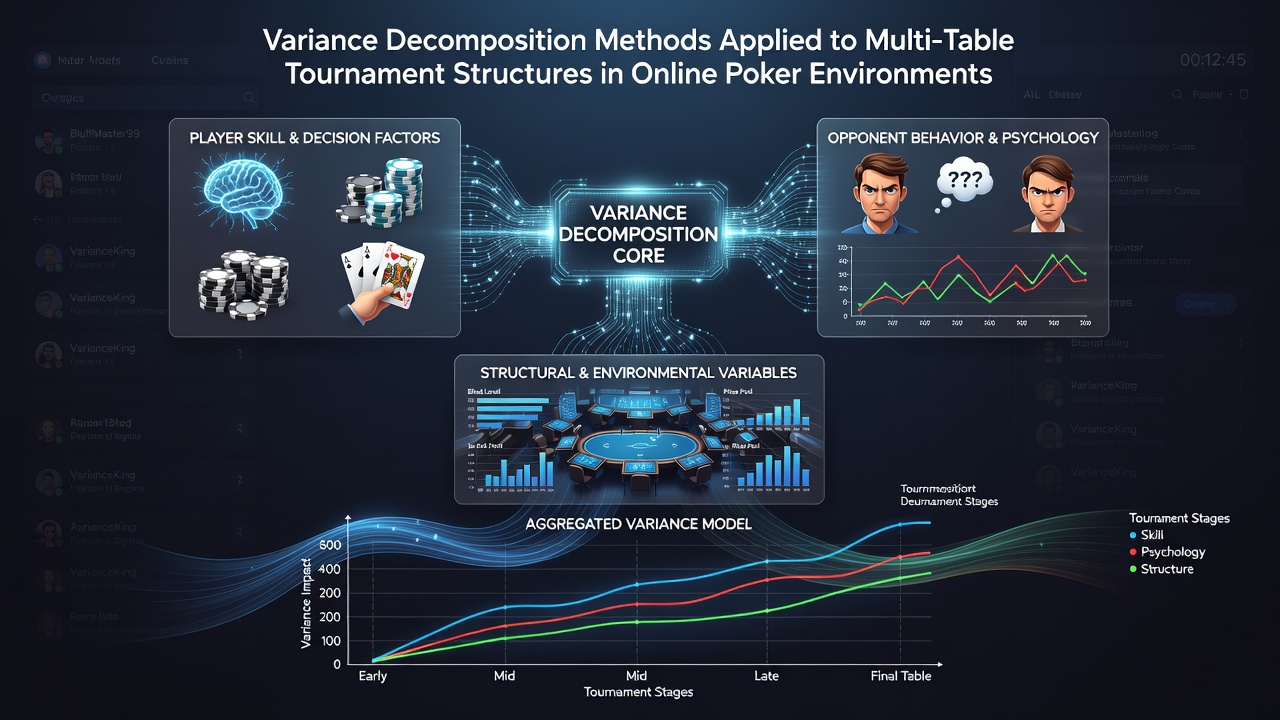
Researchers have examined variance decomposition methods as tools for isolating performance factors within multi-table tournament structures common in online poker environments, and these approaches separate total outcome variance into components tied to skill, luck, field size, and payout distributions. Data from large-scale tournament databases shows that multi-table events generate higher variance than single-table formats because players face repeated independent situations across many tables simultaneously, while stack depths fluctuate independently at each table.
Core Concepts Behind Variance Decomposition
Analysts apply techniques such as analysis of variance and regression-based partitioning to poker results, and these methods quantify how much of a player's return deviation stems from random card distributions versus consistent decision quality. Studies indicate that in tournaments with 500 or more entrants the luck component often accounts for 65 to 80 percent of short-term result swings, whereas skill edges become measurable only after thousands of hands across repeated events. Observers note that decomposition models grow more precise when researchers incorporate variables like table draw order, blind level progression, and independent chip model survival probabilities.
Application to Multi-Table Online Structures
Online platforms run thousands of multi-table tournaments daily, and variance decomposition reveals distinct patterns across different buy-in tiers and formats. In August 2026 several major sites recorded average field sizes exceeding 1,200 players for mid-stakes events, and decomposition analysis showed that early-stage survival variance contributed the largest single share of outcome spread before the money bubble. Players who tracked results over extended periods discovered that adjusting aggression frequencies at specific stack depths reduced unexplained variance by measurable percentages, while late-stage pay jump decisions introduced separate volatility spikes that standard deviation metrics alone failed to isolate.
Key Variables Isolated Through Decomposition
- Field size and payout structure ratios
- Independent chip model survival curves at each table
- Blind level duration relative to average stack depth
- Table draw position effects on early aggression opportunities
Those who modeled these factors separately found that payout structures with heavy top-heavy weighting increased variance attributable to final table dynamics, whereas flatter structures shifted more variance into the middle stages where most eliminations occur. Evidence from aggregated platform data indicates that tournaments with 15-minute blind levels produce different variance profiles than those using 8-minute levels, and decomposition separates the contribution of time pressure from pure card luck.
Implementation in Digital Poker Environments
Software tools now integrate variance decomposition routines that process hand histories from online clients, and these programs output component scores for individual players across thousands of tournaments. Research groups at institutions including the University of Nevada Reno have published frameworks that adapt classical statistical decomposition to poker, and their models account for the non-independent nature of chip stacks within the same event. Practitioners report that tracking decomposed variance components helps identify whether recent downswings stem from increased field difficulty or from deviations in personal decision patterns at specific stack sizes.
Industry reports from the European Gaming and Betting Association highlight growth in data-driven training resources that incorporate these methods, while similar approaches appear in materials distributed by Australian poker research networks. The models prove especially useful for players managing multiple simultaneous tables because they isolate variance introduced by divided attention from variance inherent to the tournament format itself.
Practical Outcomes Observed in Tournament Data
One analysis of over 40,000 multi-table tournament results demonstrated that players who maintained consistent preflop raise sizing across varying table counts reduced the portion of variance labeled as decision noise, and the reduction measured approximately 12 percent compared with control groups. Another dataset covering events from 2024 through mid-2026 revealed that late-registration players experienced distinct variance profiles, with decomposition attributing higher early-stage variance to shorter effective stack depths at entry. These findings align with simulations run by independent research teams that model thousands of tournament paths while holding player skill constant.
Conclusion
Variance decomposition methods continue to provide structured ways to separate skill signals from noise in online multi-table poker tournaments, and ongoing data collection from global platforms supplies the volume needed for reliable component estimates. Researchers expect further refinement as hand history formats standardize across sites and as machine learning techniques improve the handling of correlated variables within single events. The approach supplies tournament participants with clearer diagnostics than raw return figures alone, and adoption has spread through training communities focused on long-term result analysis.