19 May 2026
Tracing Decision Trees for Strategic Raises in Caribbean Stud Poker Variants
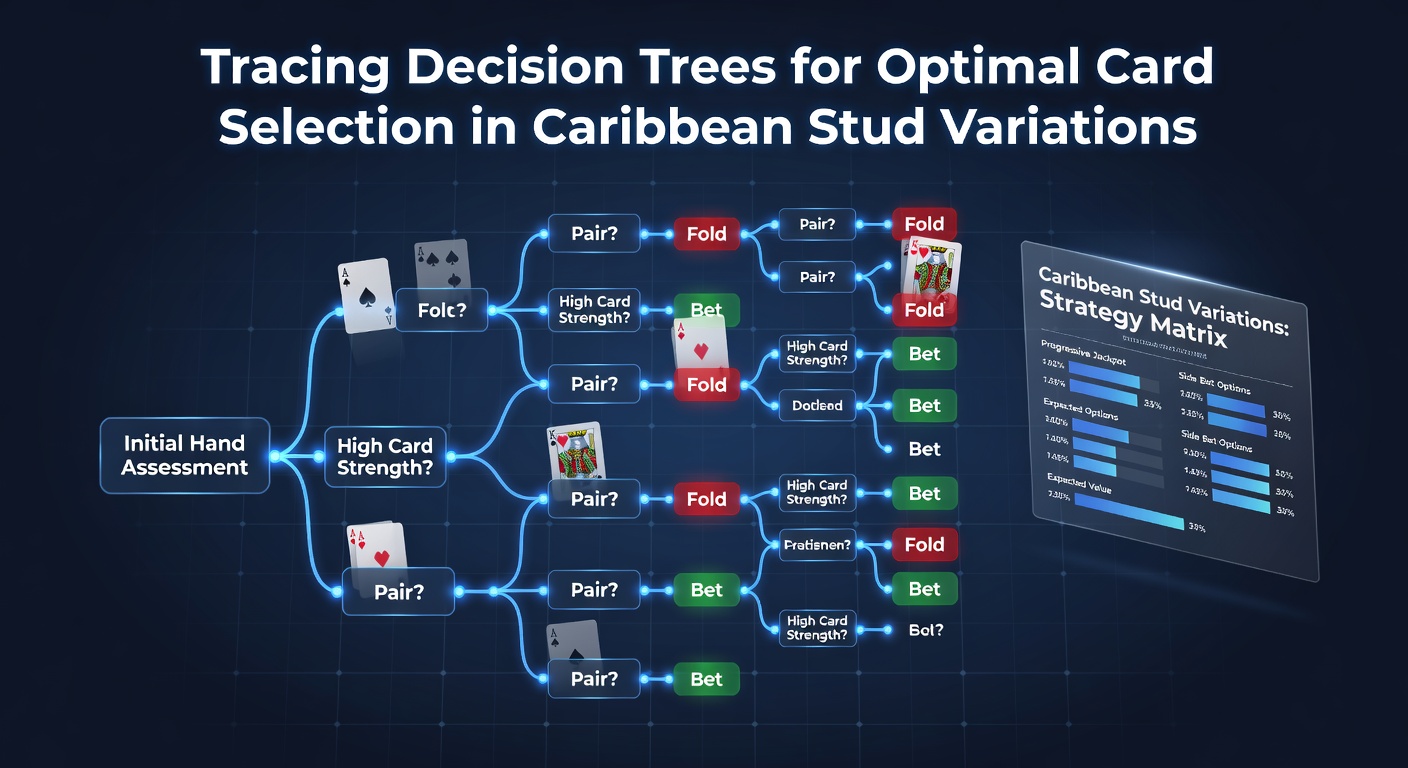
Caribbean Stud Poker presents players with five cards and a single dealer upcard, creating a clear framework where decision trees map every possible hand strength against payout structures and raise decisions, while variations in side bets and progressive jackpots add branches that shift optimal thresholds for each ante size. Analysts trace these trees by starting at the root node of hand categories such as no pair, one pair, two pair, three of a kind, straight, flush, full house, four of a kind, straight flush, and royal flush, then layering probability calculations for dealer qualification that occurs when the dealer shows an ace-king or better.
Basic strategy tables published by multiple casinos already list raise-or-fold choices for each five-card combination when the dealer upcard ranges from ace through king, yet decision trees extend this approach by incorporating conditional probabilities that account for the exact composition of remaining cards in the deck after the player’s hand is dealt. Researchers at academic institutions have published algorithms that expand these trees across millions of simulated deals, revealing slight adjustments to the standard chart when progressive jackpots exceed certain thresholds.
Core Mechanics and Tree Construction
Players place an ante before receiving cards, then decide whether to fold and lose the ante or raise with an amount equal to twice the ante, and the dealer must then hold at least ace-king to qualify or the player receives even money on the ante while the raise pushes. Decision trees capture this sequence by assigning expected values at each leaf node, where the value equals the probability-weighted sum of all possible payouts including the ante return, raise win, and any side-bet triggers. Software that builds these trees enumerates every five-card hand, calculates the exact number of dealer hands that qualify and beat it, then works backward through the branches to mark the optimal action at each decision point.
What's interesting emerges when analysts add variant rules such as optional bonus bets that pay for three of a kind or better regardless of dealer qualification. The additional payout layer inserts new nodes that alter the minimum hand strength required for a raise, because the bonus return can offset losses on marginal hands that would otherwise fold. Data from North American gaming authorities shows that progressive jackpot participation rates climb sharply once the meter exceeds 50 times the ante, prompting tree recalculations that recommend raising with certain suited connectors or low pairs that standard charts advise folding.
Handling Variant Payout Structures
Caribbean Stud appears in multiple formats that modify the pay table for the raise, teh ante bonus, or both. One common variation pays 50 to 1 on a royal flush instead of 100 to 1 while boosting lower hands such as flush or full house, and decision trees immediately reflect the change by re-ranking expected values for those categories. Another version introduces an optional five-card bonus that pays on any straight or better irrespective of the dealer outcome, inserting an extra decision node before the raise choice that weighs the fixed bonus odds against the cost of the side wager.
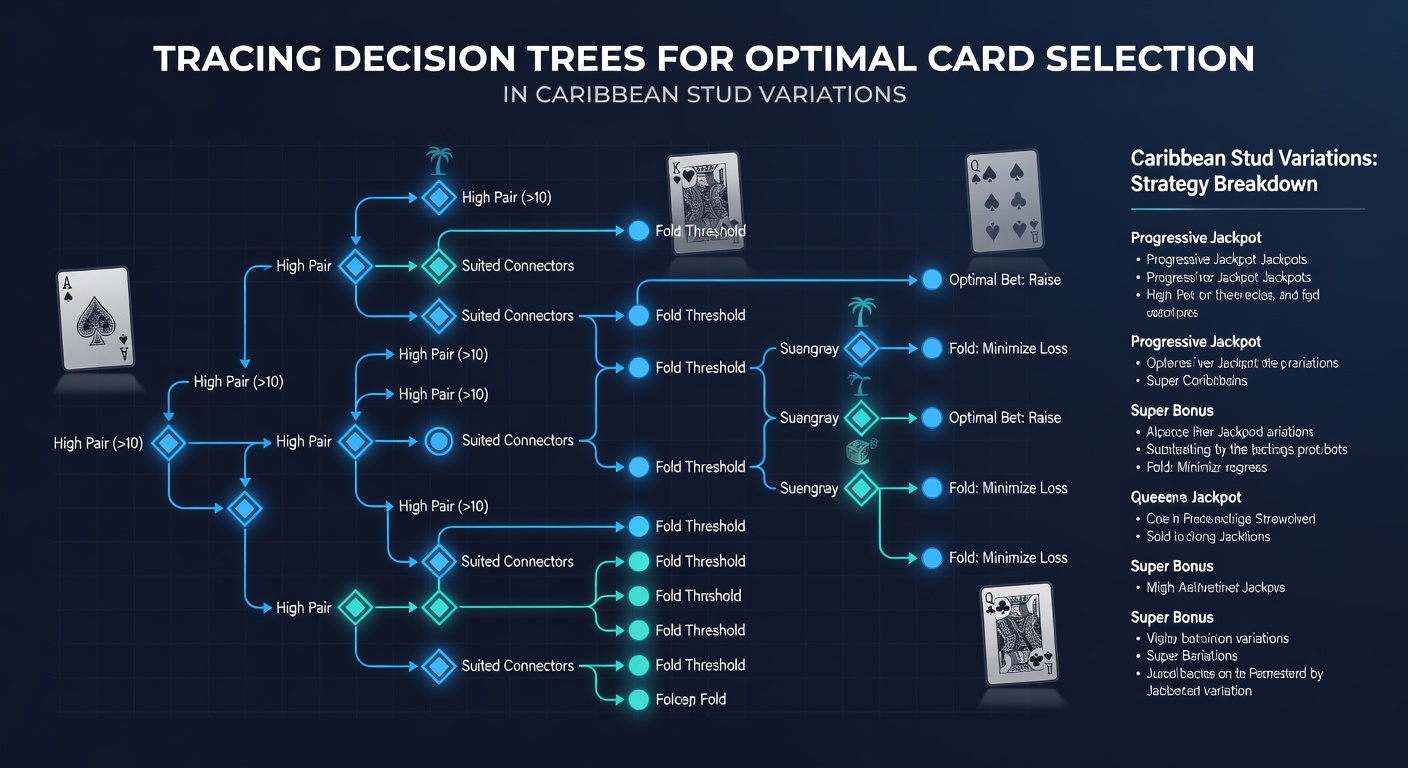
Observers note that tree depth increases when casinos offer both the standard raise and a separate progressive side bet, because the jackpot contribution must be balanced against the frequency of qualifying dealer hands. According to figures released by the Nevada Gaming Control Board, Caribbean Stud progressive meters reached record levels in early 2026, leading several operators to publish updated strategy cards that reflect the new optimal raise lines for hands containing an ace and a king with a suited kicker.
Practical Application and Software Tools
Players who wish to apply decision-tree results typically consult software that outputs color-coded charts for each variant, yet the underlying logic remains the same enumeration of remaining cards and expected-value comparison. One study released by a Canadian research group in 2025 demonstrated that following tree-derived thresholds reduced the house edge by 0.18 percentage points compared with memorized basic strategy when progressive meters sat above 75,000 dollars. The same analysis highlighted that certain suited ace-king hands shift from fold to raise once the progressive contribution exceeds 1.5 percent of the ante, a threshold that appears regularly during promotional periods.
As of May 2026 several online platforms began displaying real-time meter values directly on the game interface, allowing decision trees to be recalculated on the fly rather than relying on static charts. This integration lets players adjust their raise frequency within seconds when the jackpot climbs or drops, something that previously required manual recalculation between sessions.
Limitations and Ongoing Refinements
Decision trees assume perfect information about the remaining deck and fixed rules, yet live casino environments introduce minor variables such as multiple decks or continuous shuffles that alter exact probabilities. Analysts therefore recommend periodic re-tracing whenever a venue changes its shuffle procedure or pay table, because even small rule tweaks can flip the action on borderline hands such as ace-king with no kicker or pairs of twos through fives. Industry reports from Australian gaming regulators indicate that venues updating their Caribbean Stud variants in 2025 saw measurable shifts in player raise percentages once new decision-tree guides were posted at the tables.
Conclusion
Decision trees provide a systematic method for identifying optimal raise thresholds across the expanding range of Caribbean Stud variants by mapping every hand against dealer qualification odds and all available side-bet payouts. As progressive meters and rule modifications continue to evolve, the same enumeration techniques allow rapid updates that keep strategy aligned with current conditions. Players who incorporate these refined paths gain access to the precise expected-value calculations that static charts cannot fully capture when meters fluctuate or pay tables change.